
If you read the foundations guide, you know structure is the skeleton of SMC: uptrends print higher highs and higher lows, downtrends print lower highs and lower lows. The skeleton only becomes tradeable when a swing actually breaks — and there are exactly two kinds of break. Same candles, same chart, completely different meaning.
Break of Structure (BOS): the trend re-confirms
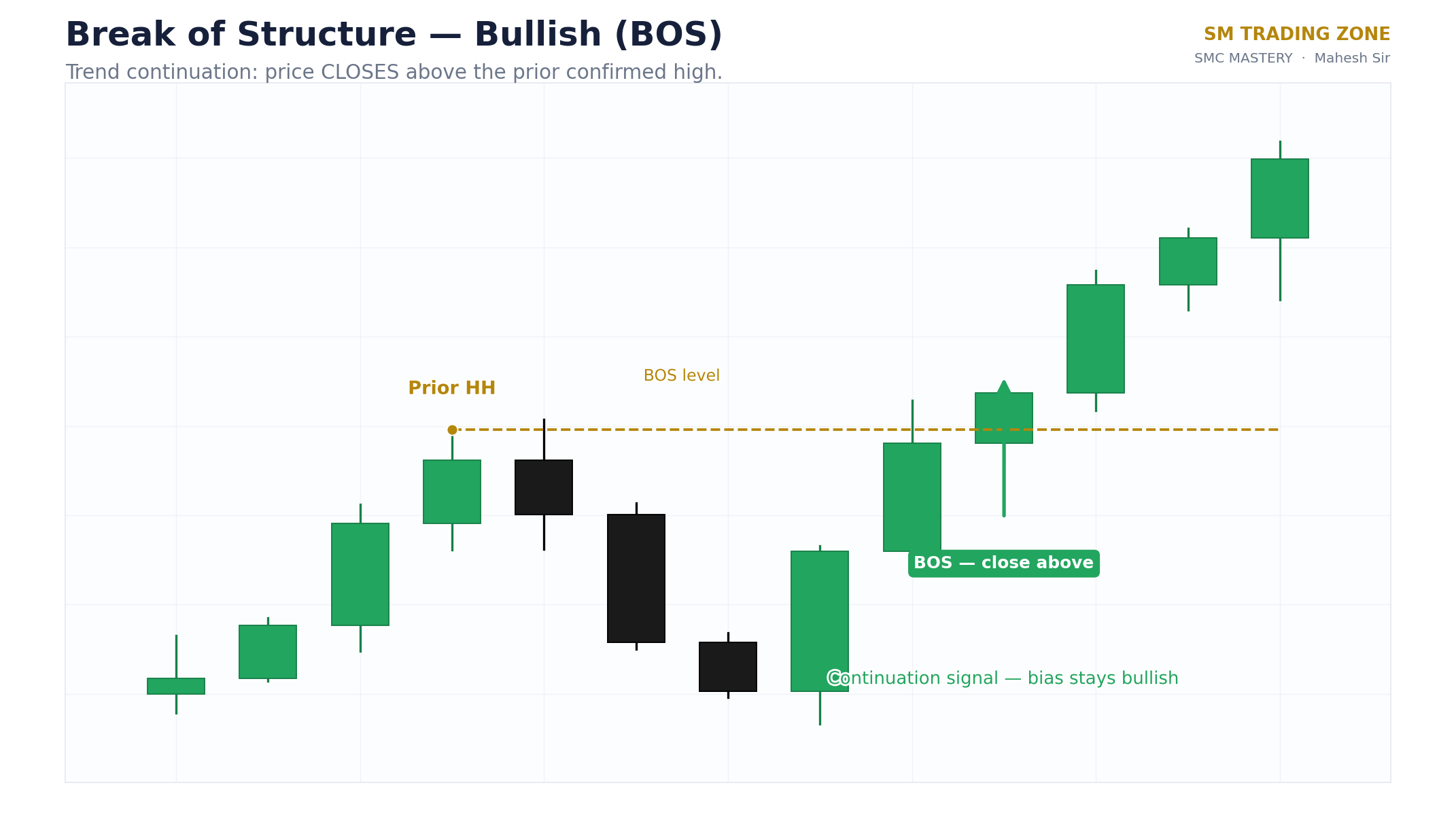
A Break of Structure happens when price breaks a swing point in the direction of the existing trend. In an uptrend, that means closing above the previous higher high. In a downtrend, closing below the previous lower low.
A BOS answers one question: is the side in control still in control? Yes. Buyers (or sellers) were willing to transact through the last extreme, which means the trend has fuel. Practically, a bullish BOS tells you two things: your bias stays long, and the pullback that follows is a buying opportunity — into a discount zone, an order block, or an FVG left by the impulse that broke structure.
Change of Character (CHoCH): the first crack
A Change of Character happens when price breaks a swing point against the trend. In an uptrend, that means closing below the most recent higher low — the level that, by definition, was supposed to hold if buyers were still in charge.
A CHoCH is not a reversal confirmation; it is a reversal warning. The market that was reliably making higher lows just failed to defend one. Sometimes that failure becomes a full trend change; sometimes it becomes a deep pullback that resumes the trend. What a CHoCH should always do is change your posture: stop adding to the old direction, protect open profit, and start watching the counter-trend leg for evidence — a BOS in the new direction is what upgrades "warning" to "new trend."
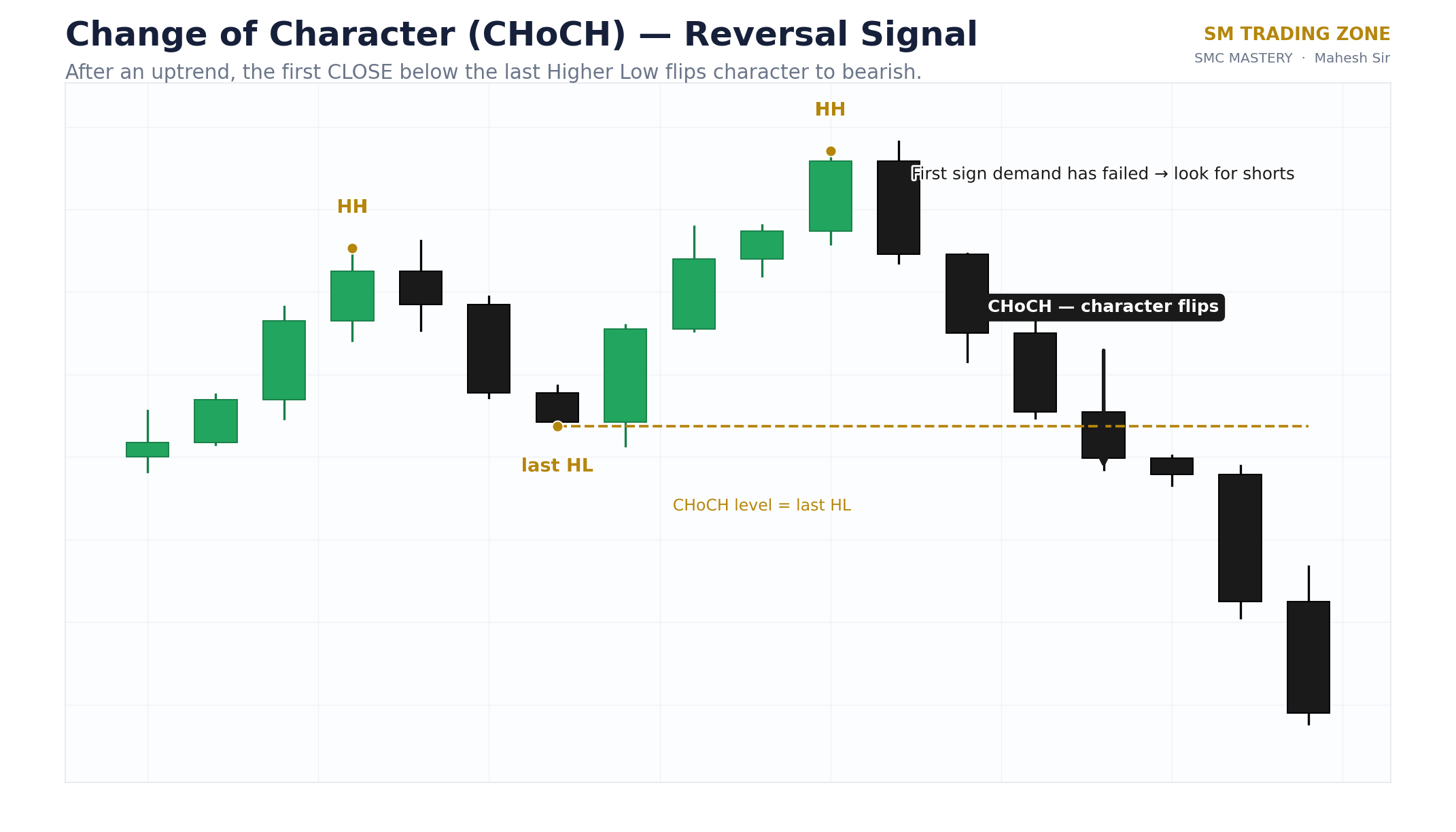
A useful mental model: BOS is the trend speaking; CHoCH is the trend stuttering. One BOS after another is a healthy trend. A CHoCH followed by an opposite BOS is a completed handover of control.
Body close vs wick break: why wicks lie
Here is where most self-taught SMC traders go wrong. What counts as "breaking" a level — any tick beyond it, or a candle closing beyond it?
Wicks are where stop hunts live. As the liquidity guide covers in detail, the area just beyond an obvious swing point is exactly where resting stop-loss orders pool — and large players routinely push price through those levels to fill their own orders, then let it snap back. On the chart, that event prints as a wick through the level with a close back inside. If you treat every wick as a structure break, you will flip your bias at precisely the moments engineered to trap you.
The fix is a mechanical rule: structure breaks are confirmed by candle body closes only. A wick through a high that closes back below it is not a BOS — it is more likely a sweep, and often a signal in the opposite direction. The body close is the market's committed statement; the wick is its bluff. This one rule removes a remarkable share of false structure signals, at the cost of slightly later confirmation — a trade-off worth making every time.
Valid swings: inducement-validated vs fractal pivots
There is a second, subtler question underneath every BOS/CHoCH call: which swing points count? Break the wrong swing and the label is meaningless no matter how clean the close.
Most indicators — and most traders — define swings with fractal pivots: any bar whose high is higher than its neighbors is a swing high. It's simple and it's mechanical, but it treats every wiggle as structure. On a fast intraday chart, fractal logic detects dozens of "swings," and consequently dozens of fake structure breaks.
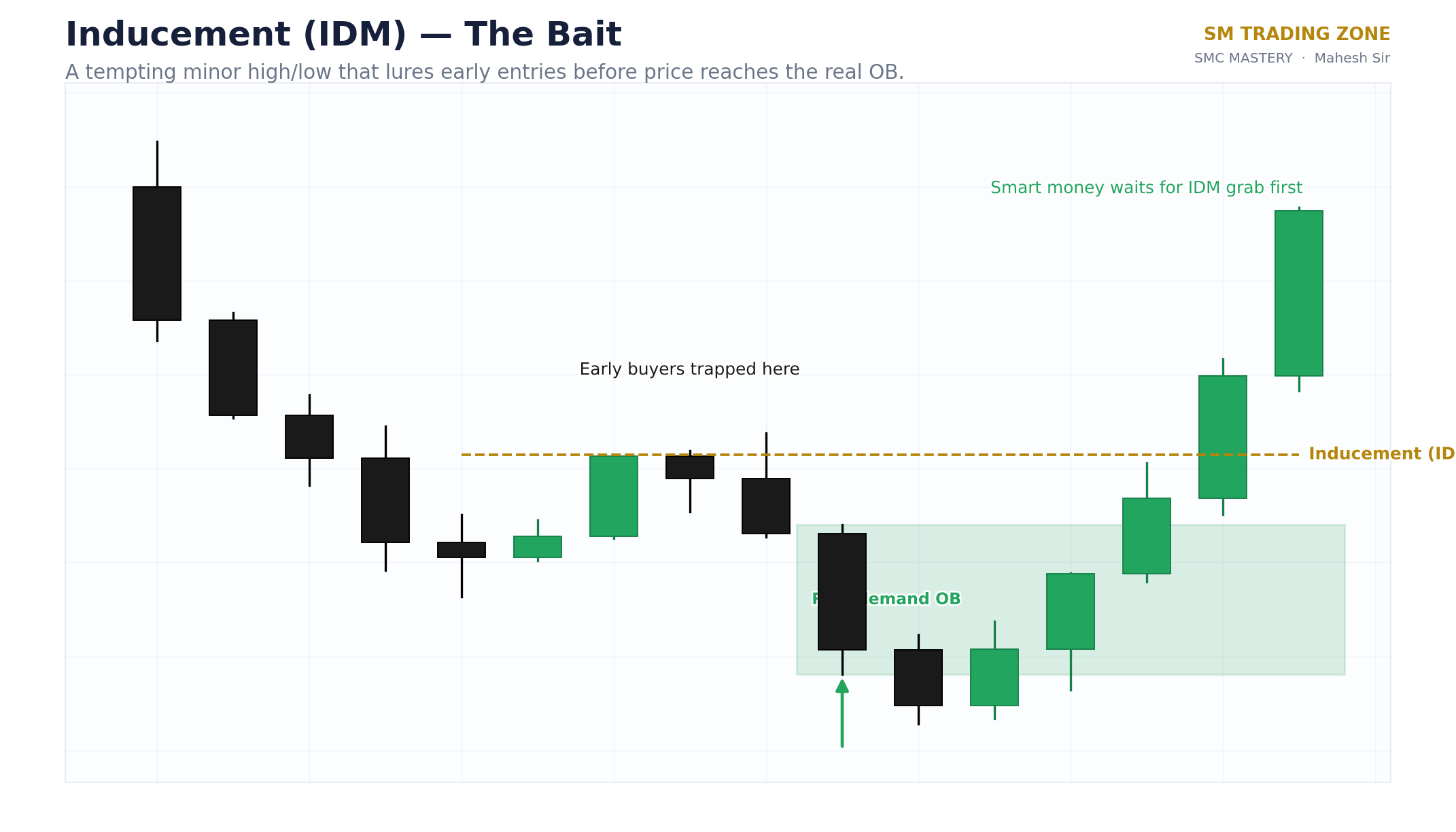
The stricter SMC approach validates swings with inducement (IDM). The idea: a swing high in an uptrend only matters if the market proved it matters — by first sweeping the pocket of liquidity that formed beneath it (the minor pullback low, where early buyers place stops). That pocket is the inducement: the bait. Once price dips through the inducement, grabs those stops, and then continues, the swing above is a validated structural point. Breaks of validated swings carry information; breaks of random fractal wiggles carry noise.
Common mistakes (and how to stop making them)
- Counting internal breaks as BOS. Inside a leg from one valid swing to another, price forms minor sub-swings. Breaking those is internal structure — useful for entry timing, but not a trend statement. Traders who label every internal break "BOS" end up believing a 5-minute wiggle overrides the hourly downtrend.
- Flipping bias on the wick. Covered above — if the body didn't close through, nothing broke.
- Treating a CHoCH as a confirmed reversal. A CHoCH alone justifies caution and, at most, a scouting position with defined risk. The higher-conviction reversal read is CHoCH → counter-trend BOS.
- Reading structure on one timeframe. A CHoCH on the 5-minute may be an ordinary pullback on the 1-hour. Decide your bias on the higher timeframe, execute on the lower — never the reverse.
- Re-drawing swings until the chart agrees with your position. The cure is mechanical rules — fixed swing definitions, body-close confirmation — applied before the trade, not after.
How SMC SNIPER marks them
Our flagship indicator, SMC SNIPER Part 1 — Structure & Order Blocks, implements exactly the rules in this guide, mechanically:
- Body closes only. BOS and CHoCH labels print only when a candle body closes through the level — wicks never count, so structure can't flip intrabar and what you see in history is what you'd have seen live.
- Inducement-validated swings. HH/HL/LH/LL labels are confirmed only after the inducement beneath (or above) them is swept — the live IDM line shows you the exact level the market still has to take.
- Closed-bar confirmation. All structure events evaluate on closed bars, with higher-timeframe data requested without lookahead — no repainting.
None of that makes the read infallible — no tool can. It makes the read consistent, which is what lets you review a hundred marked charts and learn from an honest record.
Key takeaways
- BOS breaks a swing with the trend — continuation. CHoCH breaks a swing against the trend — warning, not confirmation.
- Only candle body closes confirm a structure break. Wicks through levels are usually liquidity sweeps — often a clue in the opposite direction.
- Swings validated by inducement carry meaning; fractal pivots mostly produce noise and false breaks.
- Internal (sub-swing) breaks time entries; they do not change trend bias. Bias belongs to the higher timeframe.