
Most trading education starts with indicators: moving averages, RSI, MACD. All of them are math applied to past prices — useful summaries, but summaries of what already happened. Smart Money Concepts starts somewhere else. It starts with a question about who is trading: what does a bank, fund, or large proprietary desk have to do to move a billion dollars through a market, and what fingerprints does that activity leave on the chart?
Once you learn to look for those fingerprints, a chart stops being a squiggly line and starts reading like a sequence of decisions — accumulation here, a stop hunt there, an aggressive push that breaks the trend. That is the whole promise of SMC. Not prediction. Not certainty. A more honest description of what already happened, so your next decision is better informed.
Retail order flow vs institutional order flow
A retail trader can buy or sell almost any size instantly at the market price. Your two-lot order on gold fills in milliseconds and moves nothing. That convenience shapes how retail traders think: see a signal, click, done. Entry price is wherever the market happens to be.
An institution lives in a different world. A desk that needs to buy the equivalent of 500,000 lots cannot click "buy" once. If it tried, its own buying would chase the price up — each slice of the order filling worse than the last. Professionals call this slippage, and at institutional size it is the main cost of doing business.
So institutions do the opposite of clicking once. They split orders into pieces, execute over hours or days, and — critically — try to buy where other people are selling. Every buy order needs a sell order on the other side. The bigger your order, the more of the other side you need. This is the single most important idea in SMC:
Where do sell orders cluster? Below obvious swing lows, where the stop-losses of buyers sit. Around round numbers and previous session highs and lows. At levels where breakout traders will chase. Institutional execution gravitates to these pools, which is why price so often spikes through an "obvious" level, fills the big player, and reverses. It is not a conspiracy — it is mechanics.
The three pillars: structure, liquidity, zones
Everything in SMC hangs off three connected ideas. Learn these three and every other term in the vocabulary — order block, inducement, fair value gap — slots into place.
1. Market structure — the skeleton
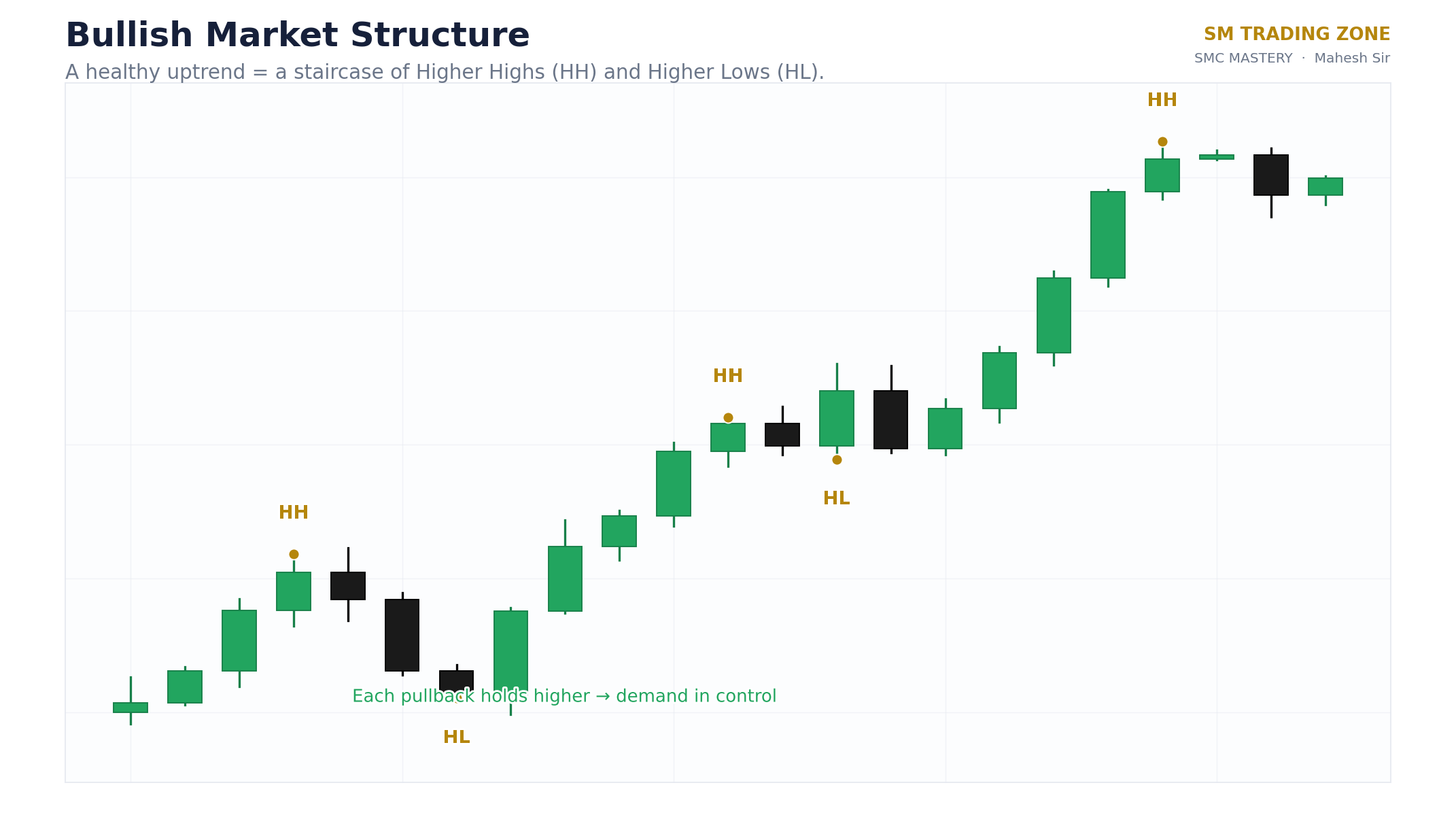
Structure is the sequence of swing highs and swing lows. In an uptrend, price prints higher highs (HH) and higher lows (HL); in a downtrend, lower highs (LH) and lower lows (LL). When price breaks a swing in the direction of the trend, that is a Break of Structure (BOS) — continuation. When it breaks the swing against the trend, that is a Change of Character (CHoCH) — the first warning the trend may be over. Structure tells you which side of the market you should even be looking to trade.
2. Liquidity — the fuel
Liquidity is where resting orders sit: stop-losses above equal highs (EQH) and below equal lows (EQL), breakout orders beyond a range, stops behind session and daily extremes. Price does not move randomly between these pools — it is drawn to them, because that is where large players can fill. A "stop hunt" that sweeps a low and instantly reverses is liquidity being consumed. Structure tells you the direction; liquidity tells you the likely destinations along the way.
3. Zones — the footprints
When an institution executes, it leaves marks. An order block (OB) is the last opposing candle before an aggressive move — a candidate footprint of accumulation. A fair value gap (FVG) is a three-candle imbalance left behind when price moves too fast for both sides to transact fairly. These zones matter because unfilled institutional interest often remains there: when price returns, it frequently reacts. Zones give you locations to do business, instead of chasing candles in the middle of nowhere.
Premium and discount: where in the range you transact
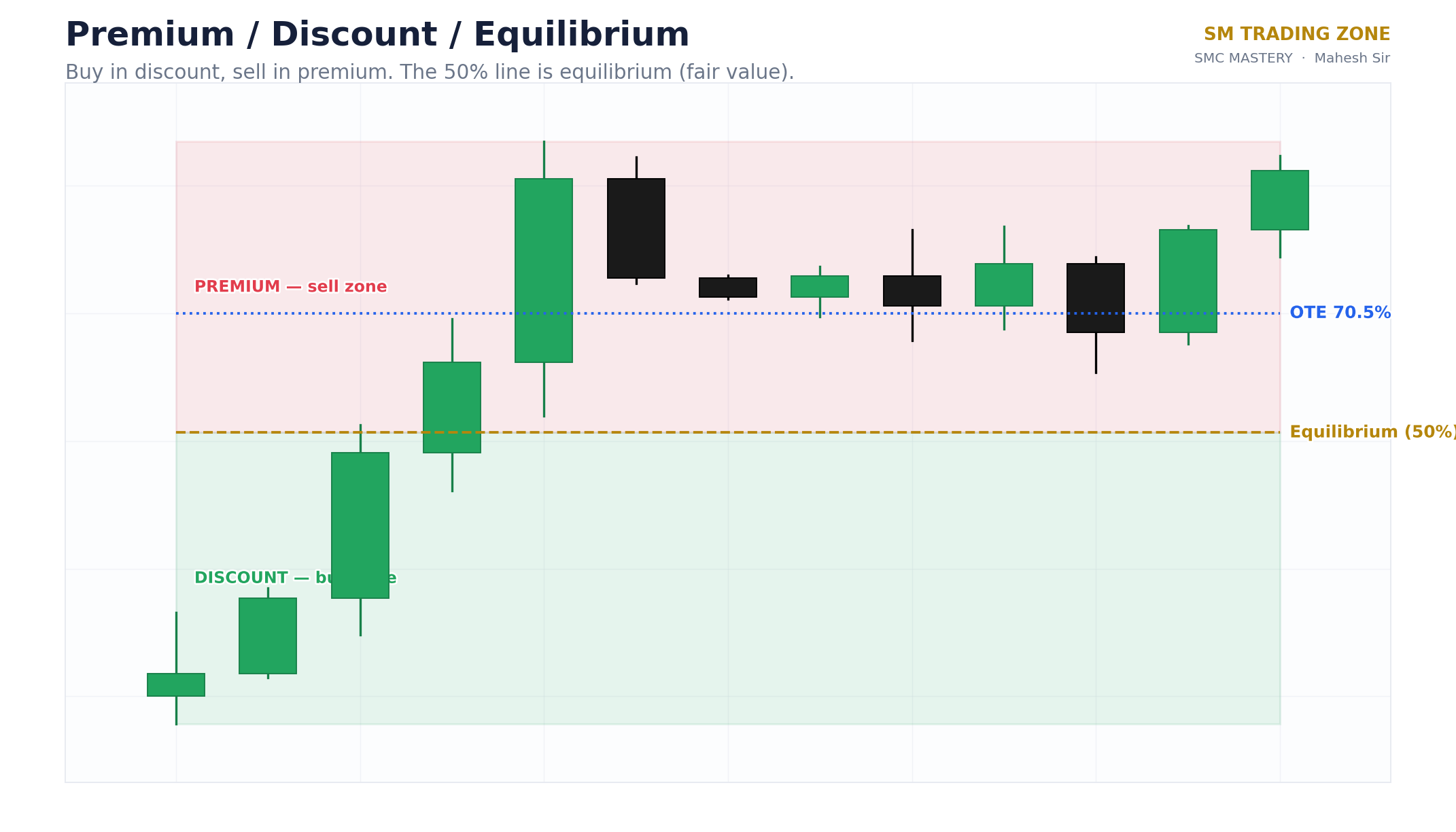
The final piece of the foundation is deciding whether a location is cheap or expensive. Take the current dealing range — the swing low to swing high that price is working inside — and split it at 50%, the equilibrium. Everything above equilibrium is premium (expensive); everything below is discount (cheap).
The logic is the same one every wholesale business uses: buy at a discount, sell at a premium. An order block sitting in deep discount within a bullish structure is a fundamentally different proposition from the same-looking zone in premium. SMC traders use premium/discount (P/D) as a filter — it doesn't create trades, it disqualifies bad ones.
What SMC is NOT
This part matters as much as everything above, because SMC attracts more hype than any methodology since Elliott Wave. So let's be blunt:
- SMC is not a guaranteed system. It is a framework for reading charts. Two competent SMC traders can look at the same chart and take different trades. Zones fail. Sweeps keep going. Anyone quoting you a win rate for "SMC" is selling something.
- SMC is not magic insight into bank orders. Nobody drawing rectangles on TradingView can see institutional order books. SMC infers probable institutional behavior from price alone — an educated inference, never a certainty.
- SMC does not replace risk management. A beautiful confluence of structure, liquidity and zone still loses often enough that position sizing and stop discipline decide whether you survive. The framework tells you where; risk management decides how much.
- SMC is not fast. Reading structure properly takes screen time. The vocabulary is learnable in a week; the judgment takes months of marked-up charts.
If that sounds less exciting than "the strategy banks don't want you to know" — good. Sober expectations are the first edge you can own.
Mini glossary: the terms you'll meet first
| Term | Meaning |
|---|---|
| BOS | Break of Structure — price breaks a swing in the trend direction; continuation signal. |
| CHoCH | Change of Character — price breaks a swing against the trend; first sign of possible reversal. |
| OB | Order Block — the last opposing candle before an impulsive move; a candidate institutional footprint. |
| FVG | Fair Value Gap — a three-candle imbalance where price moved too fast to trade both sides fairly. |
| IDM | Inducement — an engineered pocket of liquidity that gets swept before the real move from a zone. |
| EQH / EQL | Equal Highs / Equal Lows — matching extremes where stop-loss liquidity visibly stacks up. |
| P/D | Premium / Discount — the expensive (upper) and cheap (lower) halves of the current dealing range. |
Where to go from here
You now have the map: institutions need liquidity, their need creates structure, and their execution leaves zones. The next three guides zoom into each pillar — structure breaks (BOS vs CHoCH), imbalance (fair value gaps), and liquidity (sweeps and stop hunts). Read them in order, then start marking charts by hand. There is no substitute for that.
Key takeaways
- Institutions can't fill large orders instantly — they must execute where opposing liquidity exists, which makes their behavior partially predictable.
- SMC rests on three pillars: structure (trend skeleton), liquidity (where resting orders pool), and zones (footprints like order blocks and FVGs).
- Premium/discount is a filter: buy cheap in discount, sell expensive in premium — within the direction structure allows.
- SMC is a reading framework, not a guaranteed system — it needs risk management, screen time and honest record-keeping to become an edge.